



5 Ways to Reduce Costs on Sheet Metal Fabrication
Sheet metal parts get expensive for boring reasons.
Not because the shop wants to punish your purchasing team. Not because a bracket suddenly became “high tech.” Usually, the quote climbs because the design asks for extra handling, odd material, tight tolerances where they do not matter, finishing that was added late, or assembly work nobody planned for.
We see this all the time.
A part that looks simple on screen can force three press brake setups, special-order material, manual deburring, masking, rework, and a long email thread about tolerances. That is where the money goes.
Why Sheet Metal Costs Are Still Under Pressure in 2026
The old advice—“choose the right material and keep bends simple”—is still true.
But it is not enough anymore.
The Sheet Metal Products Producer Price Index hit 348.727 in April 2026, based on FRED data sourced from the U.S. Bureau of Labor Statistics. That is higher than every month listed from late 2025 through early 2026 on the same series. BLS sheet metal products PPI data shows why buyers should treat material assumptions as a moving target, not a fixed line item. (FRED)
And the market is busy. Global Market Insights estimates sheet metal fabrication services at $91 billion in 2026, with projected growth to $136.5 billion by 2035. More demand usually means more pressure on capacity, lead times, and pricing. sheet metal fabrication services market data supports that broader demand picture. (Global Market Insights Inc.)
So, how do you keep your quotes under control?
You attack the cost drivers before the RFQ leaves your desk.
1. Choose Materials Like a Buyer, Not Just an Engineer
Material choice is the first lever because it affects nearly everything after it: cutting speed, bendability, tooling wear, weldability, finish, weight, corrosion resistance, inspection, and availability.
Here is the mistake we see: a team specifies stainless steel because it feels “safer,” then later discovers that aluminum or galvanized steel would have met the real use case at lower cost.
Sometimes stainless is the right call.
Often, it is habit.
Practical Material Rules That Lower Cost
Use this filter before locking the drawing:
| Question | Lower-Cost Direction | When to Pay More |
|---|---|---|
| Does the part need corrosion resistance? | Galvanized steel, aluminum, powder-coated steel | Stainless for harsh chemicals, washdown, marine, or medical-adjacent use |
| Does the part need low weight? | Aluminum 5052 or 6061 where suitable | Thin stainless only when strength/corrosion justify it |
| Is the part hidden inside equipment? | Standard mill finish or basic protective coating | Cosmetic finish only for visible surfaces |
| Is the part structural? | Mild steel or appropriate stainless/HSLA | Aluminum only if weight reduction is worth redesign work |
| Is the material easy to source? | Stock thickness, common grades | Specialty alloys only with clear performance need |
One more thing: do not treat material thickness as an afterthought. A small gauge change can shift bend feasibility, fastener choice, rigidity, cost, and lead time.
For sourcing teams, this is where a supplier with real sheet metal fabrication support can save time before the quote turns into revision chaos.
2. Design Around Standard Gauges, Bend Radii, and Tooling
CAD lets you draw anything.
The press brake does not care.
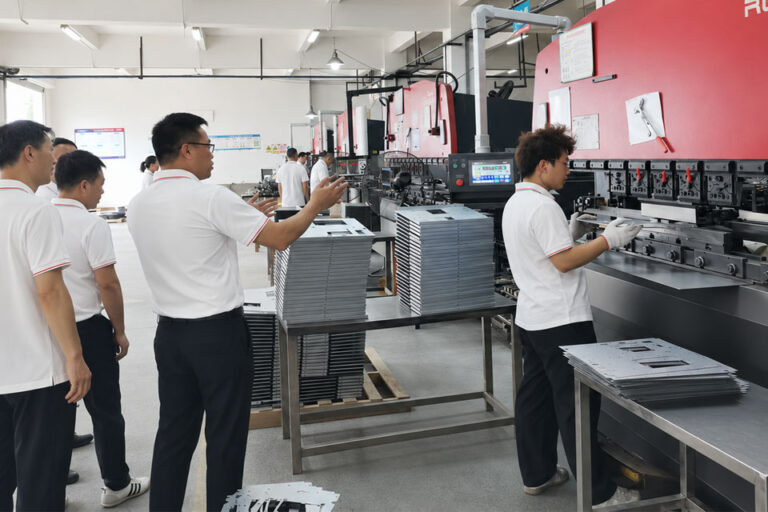
If your design needs a bend radius smaller than the material wants, the shop may need special tooling, extra inspection, or a process change. If your flanges are too short, the part may not sit correctly in the tooling. If bends fight each other, the operator has to reorient the part, which adds time and risk.
That time shows up in the quote.
Bend Design Rules That Usually Pay Off
Keep these close:
- Use standard sheet gauges whenever possible.
- Keep inside bend radius at least about 1x material thickness unless your supplier confirms otherwise.
- Avoid very short flanges on thick material.
- Keep bends in the same direction when function allows.
- Leave enough clearance near holes, slots, embosses, and hardware locations.
- Avoid deep U-shapes that trap the part during forming.
And ask early. A five-minute DFM check can remove a full setup later.
When the part depends heavily on forming accuracy, route it through a supplier experienced in sheet metal bending instead of treating bending as a generic after-step.
3. Stop Over-Tolerancing Every Feature
Tolerances are not free.
A tight tolerance tells the shop: slow down, inspect more, control more variables, maybe adjust the process, maybe scrap parts that would otherwise work perfectly.
That is fine when the feature matters.
It is wasteful when it does not.
A Better Way to Assign Tolerances
Use three tolerance zones:
| Feature Type | Tolerance Strategy | Example |
|---|---|---|
| Function-critical | Tight, controlled, inspected | Mounting hole pattern for mating assembly |
| Fit-important | Moderate tolerance | Slot position, flange width, tab alignment |
| Non-critical | Standard shop tolerance | Cosmetic edge, clearance opening, non-mating bend |
The buyer’s version is simpler: pay for precision only where precision changes performance.
Call out the truly important surfaces. Let the supplier use standard tolerances everywhere else.
BLS data also shows why labor-heavy inspection deserves attention: fabricated metal product manufacturing had average hourly earnings of $33.93 for all employees in April 2026. Every extra inspection step has a real shop-floor cost behind it. (Bureau of Labor Statistics)
4. Plan Finishing Before the Design Is “Done”
Finishing is where many cheap parts become expensive parts.
Why?
Because finishing adds constraints. Powder coating adds thickness. Anodizing may expose cosmetic flaws. Plating may require masking. Brushed finishes create grain-direction requirements. Painting may need surface prep, rack points, curing, packaging, and touch-up rules.
And if the part was not designed for finishing, the shop has to work around it.
That means hand labor.
Finish Choices and Cost Impact
| Finish Requirement | Cost Risk | Cost-Saving Move |
|---|---|---|
| Powder coating | Medium | Standard colors, clear masking notes, good drain/rack areas |
| Anodizing | Medium to high | Use suitable aluminum grade and define cosmetic zones |
| Plating | Medium to high | Avoid unnecessary masking and specify only functional surfaces |
| Brushing/polishing | High | Limit cosmetic finish to visible faces |
| Bare metal | Low | Use only when corrosion and appearance allow |
| Passivation | Medium | Use for stainless parts where corrosion performance matters |
A simple rule: do not make the entire part cosmetic if only one face is visible.
Mark cosmetic surfaces on the drawing. Mark non-cosmetic surfaces too. That gives the supplier permission not to waste money polishing the inside of a hidden bracket.
For parts where appearance, corrosion resistance, or electrical behavior matters, choose surface finishing during design—not after the PO.
5. Reduce Assembly Labor Before It Reaches the Shop Floor
This is the cost driver many teams miss.
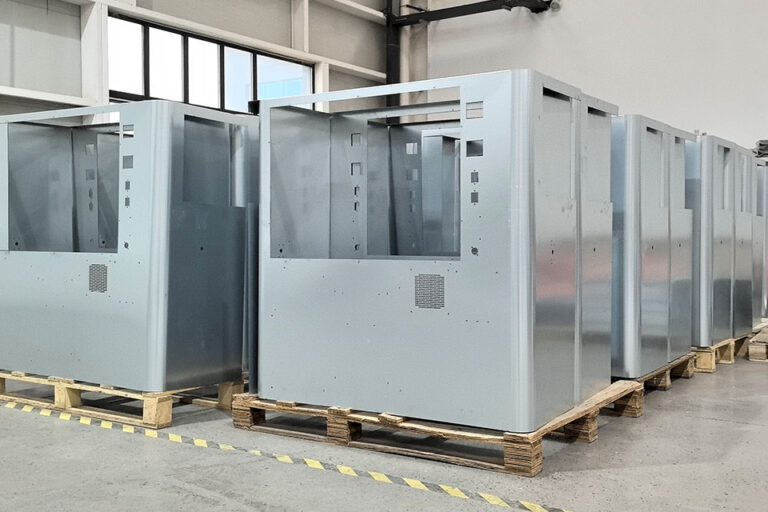
A single flat part is one thing. A finished enclosure with inserts, welds, PEM hardware, hinges, coatings, labels, and inspection is another animal.
Assembly cost comes from handling.
Pick up the part. Align it. Clamp it. Weld it. Clean it. Move it. Mask it. Coat it. Inspect it. Pack it.
Every touch adds cost.
How to Cut Assembly Cost Without Weakening the Product
Design for repeatable assembly:
- Use fewer unique fasteners.
- Standardize hole sizes.
- Use PEM hardware only where it earns its keep.
- Avoid welds where tabs, bends, rivets, or fasteners can do the job.
- Add self-locating features when parts must align.
- Keep hardware away from bend zones and edges.
- Combine parts only when it reduces total operations.
But be careful with part consolidation.
Combining three parts into one formed part may save assembly time—or it may create a nightmare bend sequence. The right answer depends on tooling, quantity, material, and tolerance stack-up.
For finished housings, chassis, brackets, and welded builds, quote sheet metal assembly as a planned process rather than a last-minute add-on.
The Cost-Control Checklist We’d Use Before Sending an RFQ
Run your next part through this list.
| Cost Driver | What to Check | Why It Matters |
|---|---|---|
| Material | Common grade and thickness? | Reduces sourcing delays and premium pricing |
| Geometry | Simple bends and accessible features? | Cuts setup time and forming risk |
| Tolerances | Tight only where needed? | Reduces inspection and scrap |
| Finish | Defined early with cosmetic zones? | Prevents masking, rework, and over-finishing |
| Assembly | Fewer touches and standard hardware? | Lowers labor content |
| Quantity | Prototype, bridge, or production? | Changes process choice and unit economics |
| RFQ package | CAD, 2D drawing, finish, material, quantity? | Reduces assumptions and requotes |
That last row matters more than people think.
A vague RFQ gets a padded quote because the supplier has to price uncertainty. A clean RFQ gets a sharper quote because the risk is lower.
What to Include in a Cost-Smart Sheet Metal RFQ
Send this:
- 3D CAD file
- 2D drawing with controlled dimensions
- Material grade and acceptable substitutes
- Thickness/gauge
- Finish and cosmetic surface notes
- Quantity breaks
- Expected annual volume, if any
- Hardware and assembly requirements
- Inspection requirements
- Target lead time
- Packaging needs
And say what can change.
For example: “Aluminum preferred, but open to steel if cost improves and powder coat meets corrosion needs.”
That one sentence gives your supplier room to help.
McKinsey’s 2025 supply-chain research found that 82% of surveyed companies had supply chains affected by new tariffs, with 39% reporting supplier/material cost increases. McKinsey’s supply-chain risk survey is a good reminder that smart sourcing now means building flexibility into the drawing and the RFQ. (McKinsey & Company)
Common Mistakes That Make Sheet Metal Parts More Expensive
Let’s call these out plainly.
Mistake 1: Specifying a Premium Material Without a Performance Reason
If the part lives inside a dry electronics cabinet, does it really need stainless?
Maybe. Maybe not.
Ask the question.
Mistake 2: Making Every Surface Cosmetic
A supplier cannot read your mind. If you do not define visible surfaces, the safe move is to assume more care is needed.
That costs money.
Mistake 3: Adding Tight Tolerances from Machining Habits
Sheet metal is not CNC milling. It bends, springs back, moves under heat, and changes during finishing.
Design for the process you are actually buying.
Mistake 4: Ignoring Bend Order
Some parts can be drawn but not formed cleanly.
A design with trapped bends, poor flange access, or conflicting features can force manual work or redesign.
Mistake 5: Treating Assembly as Someone Else’s Problem
Assembly is where small decisions compound. Hardware, welding, inserts, finish sequence, and packaging all affect cost.
Plan the build as one workflow.
When Cheap Sheet Metal Becomes Expensive
The cheapest unit price is not always the lowest total cost.
A low quote can become expensive if it causes late revisions, fit problems, cosmetic rejects, long lead times, or inconsistent repeat orders.
That is why the better question is not “Who is cheapest?”
It is: Who can help us remove cost before production starts?
That includes material alternatives, bend reviews, tolerance cleanup, finish planning, and assembly feedback.
For repeat parts, especially enclosures, brackets, panels, chassis, and production hardware, investing a little more DFM work up front can lower the part cost for every future batch of custom sheet metal parts.
Final Word: Design Less Waste Into the Part
Cost reduction is not magic.
It is usually the result of removing avoidable work: fewer setups, fewer special materials, fewer tight tolerances, fewer cosmetic surprises, fewer manual touches, fewer unclear RFQ notes.
That is the part most teams can control.
Get the design clean. Give the supplier room to suggest alternatives. Lock the finish early. Keep tolerances honest. And treat fabrication, bending, finishing, and assembly as one connected manufacturing process.
That is how sheet metal quotes get leaner without making the part worse.